
The Summer Slide Is Real — What One Long Homeschool Break Taught Me
I had always looked forward to summer — a time to wind down and have some unstructured fun. Until I started teaching my youngest!

Then fall came, and my youngest didn’t retain hardly anything. Pages he had finished in the spring might as well have been brand new. It felt like we were starting over — and it was frustrating for him and for me.
If you’re heading into a homeschool summer wondering whether to pack everything away for two months, this is the post I wish someone had handed me.
What the slide looked like at our house
It wasn’t dramatic. It was quiet. The counting that had been quick in May came out slow and unsure in September. Letters he’d known without thinking needed introducing all over again.
He remembered that he used to know it. That’s where the frustration lived, for both of us.
Here’s the detail that stays with me: it wasn’t until his second-grade year that he really understood summer meant an extended time off. Once the break made sense to him — once he could see its shape — the breaks stopped costing us so much, and I started taking them again. The slide wasn’t permanent, and it wasn’t a verdict on him or on me. But it was real.
Why the youngest learners lose the most
A preschooler’s newest skills are his most fragile ones. At 3, 4, and 5, almost everything is freshly built, and freshly built skills are held in place by repetition. When the repetition stops for eight weeks, the newest skills are the first to let go.
That’s not a deficiency in your child. It’s simply how early learning works at this age. I noticed something else, too: the skills that survived our summers were the ones attached to something he touched or lived — counting the stairs, the letters in his own name. The ones that faded were the ones that had only ever lived on a page.
What summer does to new skills
You don’t have to cancel summer
Here’s what I want you to hear, because I learned it the long way: the lesson is not “never take a break.” Your family needs the slow mornings and the sprinkler afternoons, and so do you.
The lesson is that the choice was never between a full curriculum in July and losing everything by September. Ten playful minutes, a few mornings a week, is enough thread to keep the skills connected. Not school at the kitchen table — play that happens to keep his hands and his counting warm.
The summer rhythm that worked for us
When I brought breaks back, this is what they looked like:
- One story and one page, a few mornings a week. A story he already loved, and one playful page that went with it. Five to ten minutes, done before the day got hot.
- Counting things he could hold. Blueberries in the bowl, steps to the porch, shells in a bucket. Summer hands numbers to you all day long.
- He picked. When a child chooses the page, you’re not negotiating — he’s leading. He was far more likely to finish what he’d picked himself.
- Skipped days didn’t count against us. It’s a rhythm, not a schedule. A rhythm survives a beach week.
Keep the pages — September will thank you
One more habit that changed our falls: I kept what he finished. Every traced path and counted page went into a folder over the summer.
Come September, that folder did two jobs. It showed me exactly where he was — no guessing, no starting over blind. And on the days the slide worry crept in, it answered quietly: here’s what he held onto, and here’s what we’ll warm up first. Proof on paper is steadier than a memory of May.
One playful page at a time
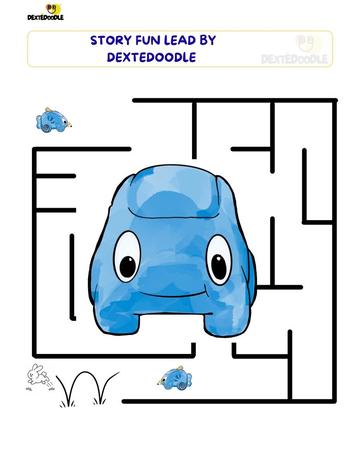
If you want the low-effort version of that summer rhythm, start with our free Mini Micro Stories maze pack — 12 tiny stories, each with a counting maze, led by Dexte. Print a page, read the story together, and let them trace their way through it before the pool. No prep, no table standoff — just read, move, color, and create.
Grab the free maze pack and keep summer exactly what it should be: a break that doesn’t cost you September.
Get the Free Kindergarten-Readiness Checklist
Every kindergarten-readiness skill on one simple printable — so the quiet “is he behind?” becomes a list you can watch him reach for, one check at a time.
Take the free readiness check →Would you rather have it as a printable? Pop your email in and the PDF comes straight to your inbox.
No spam — just readiness help from one homeschool mom. Unsubscribe anytime.
Keep summer, keep the skills
DexteDoodle Story Learning is one story told as a maze, a coloring page, a seek-and-find, and a drawing page — a few playful minutes a morning that carry counting and pre-writing straight through to September.
Get DexteDoodle Story Learning →
Before you go
I read every note. If this helped — or you’re not sure where your child is on the road to kindergarten — I’d love to hear from you at kasandra@dextedoodle.shop.